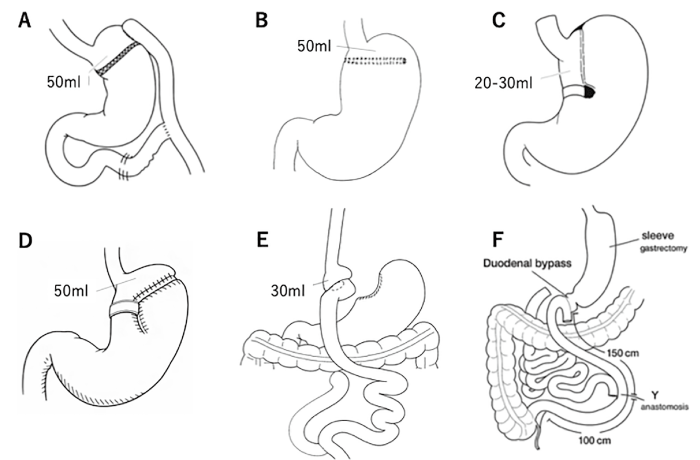
Fig. 1 Representative surgical procedures performed by Dr. Isao Kawamura.
(A) Gastric Bypass, one of the earliest bariatric procedures performed by Dr. Kawamura. This procedure was inspired by the restricted food intake observed in patients after total gastrectomy, in which approximately 90% of the stomach is bypassed and anastomosed to the small intestine to limit food intake. Reanastomosis with the bypassed stomach is technically feasible if required in the future; (B) Horizontal Gastroplasty, in which a 7-mm gastric tube is placed intragastrically and the stomach is horizontally partitioned from the lesser to the greater curvature using a linear stapler, creating a gastric pouch of approximately 50 mL. The tube is then replaced with a 12-mm gastric tube, and the channel is circumferentially reinforced with longitudinal seromuscular interrupted sutures; (C) Vertical Banded Gastroplasty (VBG) , in which a circular stapler is used to create a window through the anterior and posterior gastric walls approximately 9 cm distal to the angle of His and 3 cm from the lesser curvature. A linear stapler is then fired vertically toward the angle of His to create a vertically oriented gastric pouch with an approximate volume of 30 mL under 70 cmH2O pressure; (D) K-Gastroplasty, in which, following vertical partitioning, the stomach is transected obliquely using a linear stapler to prevent staple-line disruption, and the transection line is buried with sutures. A 1-cm gastric tube is inserted to avoid excessive stenosis, and a matrix mesh with a circumference of approximately 5 cm is placed around the channel; (E) Extended Gastric Bypass, in which a small gastric pouch (approximately 30 mL) is created, providing restrictive effects combined with mild malabsorption through small-intestinal bypass; (F) Sleeve Gastrectomy with Duodeno-Jejunal Bypass, in which sleeve gastrectomy involves longitudinal resection of the greater curvature of the stomach to create a tubular gastric conduit while preserving the pylorus, followed by duodenojejunal anastomosis. The length of the alimentary limb (approximately 75-100 cm) is relatively long to minimize nutritional malabsorption.