




Chiba Medical J. 102E:43-47, 2026
doi:10.20776/S03035476-102E-2-P43
〔 Opinion 〕
Kensuke Yoshimura, Ken Miho, and Hidekazu Iida
Center for Next Generation of Community Health, Chiba University Hospital, Chiba 260-8677.
(Received November 26, 2025, Accepted December 23, 2025, Published June 10, 2026.)
Japan’s border-health system - one of the oldest in the world - was tested to its limits during the COVID-19 pandemic. Drawing upon first-hand observations from Narita International Airport, this Communication analyzes how a framework rooted in the Quarantine Act (1879) and aligned with the International Health Regulations (2005) responded to a global health crisis. Although Japan maintained strong surveillance and laboratory capacity, hierarchical rigidity, paper-based workflows, and limited surge staffing undermined adaptability. The tripartite CIQ (Customs-Immigration-Quarantine) structure, historically praised for stability and accuracy, became fragmented under emergency conditions. Frontline officers faced extreme workloads and psychological stress while being excluded from occupational-safety protections. Complex jurisdictional boundaries between national and prefectural authorities further delayed patient coordination. Three strategic priorities are proposed: (1) inter-ministerial staffing flexibility, (2) comprehensive digital integration, and (3) institutionalized occupational and psychosocial support. Protecting those who defend the borders is inseparable from protecting public health.
COVID-19, quarantine, Japan, occupational health, border control, public health preparedness
Japan’s quarantine administration, established in 1879 to prevent cholera and plague, has evolved into a nationwide network under the Ministry of Health, Labour and Welfare (MHLW) [1]. Thirteen main stations and more than 100 sub-offices operate at ports and airports across the country. The system successfully prevented domestic transmission during SARS (2003) and pandemic influenza (2009) [2,3], but COVID-19 posed an unprecedented stress test. The framework was designed for short-term outbreaks, not for a multi-year, globally interconnected pandemic.
The Quarantine Act provides the domestic legal foundation, while the International Health Regulations (2005) establish Japan’s international obligations. COVID-19 revealed gaps between these frameworks and the realities of modern crisis management-particularly in digital interoperability, human-resource flexibility, and intergovernmental coordination.
It should be noted that the effectiveness of border quarantine measures is inherently time-dependent, with the greatest impact observed during the overseas outbreak phase and the early stage of domestic transmission. The present analysis therefore focuses on structural preparedness that can function across different epidemic phases, rather than disease-specific countermeasures.
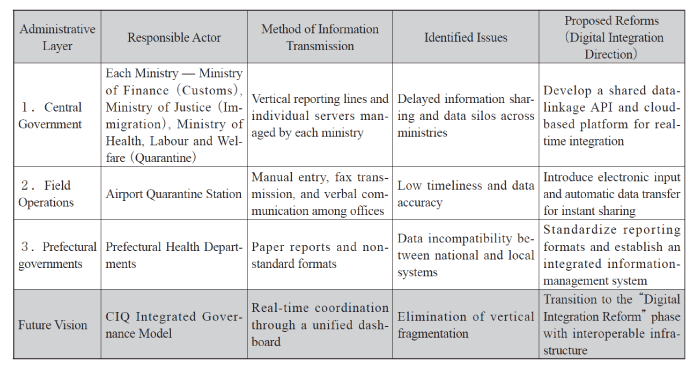
Japan’s CIQ model comprises three ministries: Finance (Customs) , Justice (Immigration) , and Health, Labour and Welfare (Quarantine) . Each operates independently with separate reporting systems. Under normal conditions this separation ensures efficiency; however, during the pandemic, it led to fragmented communication and delayed decision-making. Most documentation remained fax-based or handwritten[5,6]. Late implementation of digital tools such as MySOS and Visit Japan Web improved passenger management but lacked interoperability across ministries. The administrative culture emphasized compliance over adaptability, producing precision at the expense of flexibility. Table 1 summarizes the information flow, key challenges, and policy directions observed during COVID-19.
Table 1 Information flow structure of Japan’s CIQ system during COVID-19 and its implications for future preparedness
At Japan’s busiest international gateway, quarantine officers conducted testing, interviews, and transport coordination for thousands of travelers each day[5,7]. Staffing shortages became critical, forcing the government to hire private physicians and nurses under temporary contracts, often with minimal orientation[8]. Overlapping authority among ministries led to duplicated work and blurred accountability. As Kazunari Tanaka documented in his 2022 book What Happened at Narita Airport: The Hidden Story of Japan’s Quarantine Frontline, dedicated professionals sustained operations through personal commitment rather than institutional design[2,7,9].
Quarantine stations operate under national authority, while hospitals and isolation facilities are managed by prefectures. During infection surges, national officers had to negotiate patient transfers with prefectural governments, resulting in delays once local capacity was exhausted[9]. In prefectures hosting major international gateways such as Narita and Haneda airports, cross-airport patient allocation and accommodation arrangements were implemented during the COVID-19 pandemic. These experiences suggest that regions with large international entry points may require special institutional arrangements, such as designated frameworks or functional “special zones,” to enable rapid coordination between national and local authorities. The 2024 Government Action Plan for Infectious Disease Preparedness identified this misalignment as a key governance gap[10]. Establishing a permanent, unified command structure between ministries and prefectures remains essential to avoid similar failures in future emergencies [11].
Behind the administrative framework were individuals working under extreme stress. Quarantine officers, excluded from the Industrial Safety and Health Act, lacked occupational-health oversight and mental health support [7,8]. They worked long hours in protective gear and faced verbal abuse from frustrated travelers. Studies among healthcare workers indicated that over 40% experienced depressive symptoms during the pandemic, a trend likely mirrored among quarantine staff.
During the pandemic, the concept of “essential workers” gained widespread public recognition, largely through media coverage of frontline activities rather than through legal or regulatory frameworks. Such societal acknowledgment and public empathy may function as an important lubricant for crisis response systems, complementing formal institutional measures.
Embedding occupational health and psychosocial care into public administration is both a moral obligation and a prerequisite for sustained crisis readiness [11,12].
Japan’s experience highlights five policy priorities:
1.Flexible human-resource deployment - Legal reforms to enable cross-ministerial mobility and establish a reserve pool of trained clinicians for quarantine operations [8,13].
2.Digital integration and real-time data sharing - Replace paper-based workflows with interoperable digital systems connecting ministries and prefectures [11,14].
3.Occupational and psychosocial support - Extend occupational-safety coverage to quarantine officers and provide counseling and peer-support programs modeled on aviation-sector practices [12].
4.Unified crisis command - Establish a permanent inter-ministerial coordination office within the CIQ framework for centralized decision-making and communication[10]. The complexity of communication during COVID-19, involving multiple ministries and expert bodies, was often difficult for the public to understand. Recent institutional reforms, including the establishment of the Japan Institute for Health Security (JIHS) , reflect an effort to clarify command structures and may play a critical role in future border-health governance.
5.Institutional learning - Conduct transparent post-crisis evaluations and disseminate lessons, as recommended by the Cabinet Secretariat’s Expert Meeting on COVID-19[11]. These reforms would transform Japan’s quarantine administration from a compliance-driven inspection body into a resilience-based, human-centered public health institution.
COVID-19 demonstrated that even mature systems falter when procedural precision outweighs adaptability. Japan’s next stage of preparedness must modernize and humanize border health. Cross-sector coordination, digital transformation, and workforce protection are not technical improvements - they are ethical imperatives. At the same time, Japan’s quarantine system demonstrated several strengths during the COVID-19 response, including a long-established legal framework, a trained professional workforce, and the consistent positioning of border health as a core governmental responsibility. These strengths provide a foundation upon which future reforms can be effectively built. By breaking vertical silos and protecting frontline staff, Japan can transform its quarantine administration from an instrument of control into one of resilience, offering a model for future global health crises.
KY conceived the study design, conducted the primary analysis, and drafted the manuscript.
KM and HI contributed to the interpretation of policy implications and provided critical revisions to the manuscript.
All authors reviewed and approved the final version and agree to be accountable for all aspects of this work.
This work was partially supported by the Ministry of Health, Labour and Welfare research grant,“ A Study on Health Crisis Management and Human Resource Development at Quarantine Stations” (Yoshimura et al., 2022) . No additional funding was received.
The authors declare no conflicts of interest associated with this manuscript.
The authors served as commissioned quarantine officers during Japan’s COVID-19 response and received the standard remuneration determined by the Ministry of Health, Labour and Welfare.
Not required.
Not applicable.
The authors express sincere appreciation to all quarantine officers, nurses, and administrative staff at Narita International Airport for their dedication during the COVID-19 pandemic.
The authors also thank colleagues at the Ministry of Health, Labour and Welfare and at Chiba University Hospital for their continuous support in policy analysis, operational coordination, and public-health research.
In addition, the authors would like to express their respect and gratitude to Ms. L. Hirotani for her dedicated contributions to data processing and operational support throughout the conduct of this study.
Address correspondence to Dr. Kensuke Yoshimura.
Center for Next Generation of Community Health,
Chiba University Hospital, 1-8-1 Inohana, Chuo-ku, Chiba 260-8677, Japan.
Phone: +81-43-226-2762.
E-mail: kensuke0511@chiba-u.jp
