




Chiba Medical J. 102E:49-52, 2026
doi:10.20776/S03035476-102E-2-P49
〔 Opinion 〕
Kensuke Yoshimura, Ryuji Suzuka, Keiji Muramatsu, and Daisuke Sato
Center for Next Generation of Community Health, Chiba University Hospital, Chiba 260-8677.
(Received October 13, 2025, Accepted January 22, 2026, Published June 10, 2026.)
Japan’s healthcare system has long equated equity with geographical proximity, a logic rooted in postwar conditions. Today, population aging, multimorbidity, and workforce constraints expose the limits of this approach. Evidence from payment reforms and regional practice shows that excessive dispersion of services can dilute expertise and undermine quality. As travel distances to specialized care increase, particularly in suburban areas, the policy question shifts from keeping care close to ensuring equitable access to competent care. This opinion advances Acceptance of Distance as a necessary ethical and policy shift. Distance affects patients differently across the life course: children and frail late older adults require strong emergency reliability and mobility support, while many working-age and early older adults can accept longer travel when care is predictable and coordinated. Crucially, transportation barriers disproportionately increase unmet healthcare needs among frail older adults, meaning distance without support becomes exclusion rather than equity.
When combined with transportation policy, transparent referrals, and digital continuity, distance can function as social solidarity - protecting quality while maintaining fairness. Japan must move from proximity-based equality to competence-based fairness, reframing distance as an intentional design choice in an aging society.
Regional healthcare, Healthcare accessibility, Quality of care, Centralization, Acceptance of Distance
Japan’s postwar health system has long equated fairness with geographical proximity, resulting in a dense distribution of hospitals across municipalities. This logic emerged during a period when transportation infrastructure was limited and emergency medicine was underdeveloped. While this network improved nominal access, it also fragmented expertise and diluted the ability of clinical teams to maintain procedural proficiency. Early analyses of Japan’s per diem prospective payment system (DPC/PDPS) demonstrated that higher-volume facilities consistently achieve better outcomes and more efficient resource use[1]. These findings suggest that excessive proximity—though intuitively comforting—can paradoxically undermine quality.
Kissick’s classical “Iron Triangle” framework describes tensions among access, cost, and quality[2]. Yet Japanese scholarship has argued that this U.S.-derived model does not fully apply to Japan’s universal and cooperative healthcare system[3]. Domestic evaluations increasingly show that proximity-based equality is no longer suited to the needs of an aging society facing multimorbidity and workforce shortages[4]. These pressures raise a critical question: Should fairness be defined as universal closeness, or as equitable access to competent care-even when such access requires travel?
Ichihara City (population ~270,000) , located in a suburban region, illustrates this challenge. Over the past decade, shifts in hospital functions - including reductions in night-time emergency capacity, obstetric beds, and acute-care units ― have increased travel times for acute cardiovascular and perinatal emergencies from 20-25 minutes to 35-45 minutes in certain districts.
In response, the Ichihara City Healthcare Vision, aligned with the Ministry of Health, Labour and Welfare’s Regional Healthcare Vision 2040[5], outlines a structured role-sharing approach:
1.Centralization of acute and high-risk care in designated regional hubs;
2.Reinforcement of municipal hospitals to focus on chronic care, diagnostics, and community-based services;
3.Distance-mitigation strategies such as transportation support, transparent referral pathways, and real-time emergency acceptance dashboards;
4.Digital follow-up using telemedicine and shared electronic health records. These measures reflect broader national strategies addressing physician maldistribution and the need for coordinated regional healthcare[6].
Distance carries ethical significance. Yoshimura and Hirai emphasize that moving toward a 2040-aligned healthcare system requires “shared acceptance of redistribution,” recognizing that high-quality care may necessitate travel [6]. Digital integration can reduce psychological and logistical burdens, particularly for psychiatric and chronic disease management [7], and aligns with OECD recommendations for ensuring equity while improving system efficiency in Japan’s healthcare reform efforts [8].
When supported appropriately, distance functions as a form of social solidarity:
・Patients travel farther for advanced clinical excellence;
・Local providers reinvest in prevention and chronic care;
・Municipalities create infrastructure ensuring that no one is left behind.
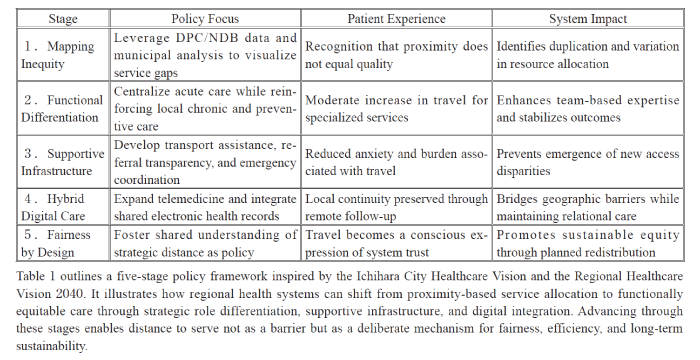
These principles are embodied in a staged policy framework (Table 1) , outlining actionable phases of reform.
Table 1 A staged framework for sustainable regional healthcare reform
Acceptance of travel distance varies across the life course, shaped by differing health needs, digital literacy, family support structures, socioeconomic conditions, and mobility.
・Children
Children rely heavily on rapid emergency response and caregiver decision-making. Pediatric emergencies are time-critical, and national data show that transport time significantly influences survival in pediatric out-of-hospital cardiac arrest [9]. Distance acceptance among families depends more on trust in triage capacity and emergency system reliability than on distance alone.
・Adolescents and working-age adults
This population generally shows high adaptability because of mobility and digital literacy. Hybrid care aligns with value-based competition principles centered on coordination and outcomes [10]. Still, socioeconomic variation-such as employment instability or lack of paid leave-modulates travel acceptability.
・Early older adults
Individuals aged 65-74 often maintain independence but manage multiple chronic conditions. Studies show outpatient utilization declines significantly when transportation access is limited, underscoring sensitivity to navigational difficulty rather than distance per se[11]. Travel becomes acceptable when supported by predictable coordination, transport services, and care-manager guidance.
・Late older adults
Late older adults (75+) face the greatest burden: frailty, sensory impairment, and social isolation intensify the challenge of travel. Transportation barriers significantly increase unmet healthcare needs among frail older adults[12]. Without escort services, community driver programs, or municipal mobility support, distance risks becoming exclusion rather than fairness.
Across all age groups, distance acceptance improves when the benefits of travel are clear, logistics are predictable, emergency access is reliable, and digital continuity minimizes unnecessary visits.
OECD reports conclude that Japan can improve quality and efficiency by integrating centralized expertise with decentralized continuity[13,14]. Unlike fragmented multi-payer systems, Japan’s universal insurance model enables coordinated regional planning, reducing zero-sum tensions between cost, access, and quality. Functional differentiation, paired with digital support, reframes distance as an asset rather than a barrier.
Japan must transition from proximity-based equality to competence-based fairness. When supported through transportation policy, referral transparency, and digital integration, distance becomes an intentional design principle that sustains clinical quality and strengthens public trust. The journey may lengthen, but the care will deepen.
Kensuke Yoshimura conceived the manuscript, integrated national policy data and comparative evidence, and drafted the paper.
Ryuji Suzuka collected relevant literature and contributed to the critical review and interpretation of prior studies.
Keiji Muramatsu and Daisuke Sato contributed analytical insights based on domestic healthcare policies and practical implementation experience.
None.
The authors declare no conflict of interest.
Not required.
Not applicable.
The authors thank Mr. Takahiro Hirai and Mr. Suguru Ishizuka for their collaboration on regional healthcare reform studies.
Address correspondence to Dr. Kensuke Yoshimura.
Center for Next Generation of Community Health,
Chiba University Hospital, 1-8-1 Inohana, Chuo-ku, Chiba
260-8677, Japan.
Phone: +81-43-226-2762.
E-mail: kensuke0511@chiba-u.jp
